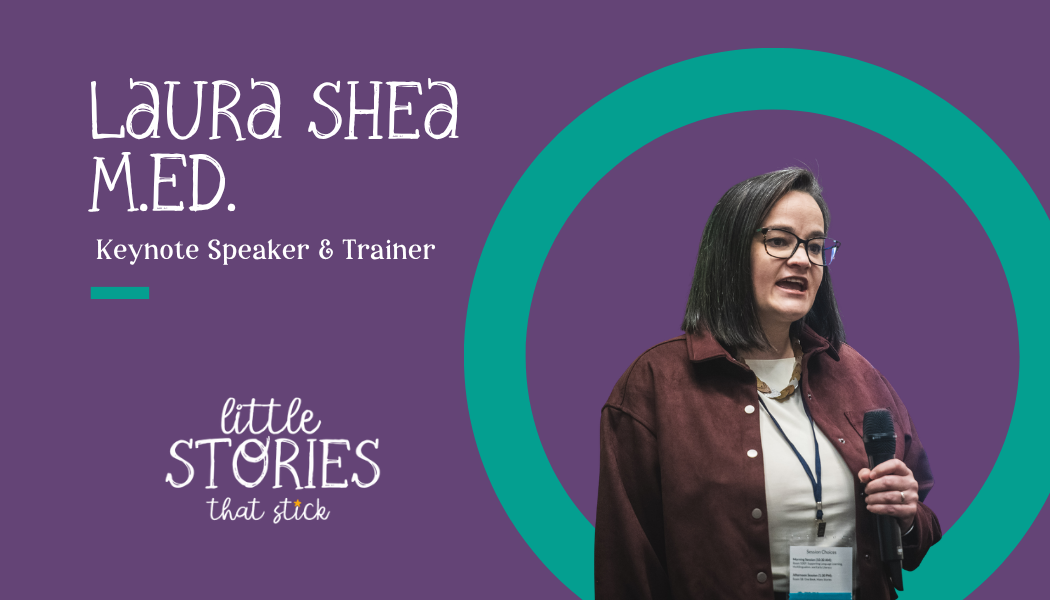
Natural Literacy Development with Leah McDerrmott
===
Laura: [00:00:00] Welcome to season three of Stories That Stick. I am thrilled to have an incredible guest with me, somebody I've been looking up to for years as I've been on my own unschooling journey. Today we're gonna talk all about natural literacy development unschooling and what this can look like in practice for educators, caregivers, and homeschoolers.
Speaker 2: Welcome to Stories That Stick with me, Laura, as your resident storyteller. I'm here to show you how oral stories inspire and captivate minds young and old. Tune in each week to hear a compelling story and join in meaningful conversations. I'll be digging deep into the heart of storytelling. Connection and listening.
So whether you're a kid, teacher, caregiver, grandparent, or simply a lover of stories, this podcast is for you. Join me as you get lost in another world and discover how stories shape our lives. [00:01:00] Here's to the next page in our story.
Laura: I have Leah McDermott here, an educator, author, and the founder of Bridge Academy and your natural learner. There are two globally recognized platforms that support families who are breaking free from traditional education models. And Leah and I are gonna talk today about unschooling and natural literacy development.
I am excited to hear how maybe our trajectories of life have been paralleled and, where we both are now. So, Leah I'd love to have you share a little about yourself and what's brought you to the work that you're doing now.
Leah: Yeah. Hey, thanks so much for having me. I'm really excited we finally got a chance to sit down and talk together.
my journey's kind of like a full circle. I was, labeled a gifted kid in the early eighties, which just kind of turns into, you know, early nineties, I guess, more work for kids. , And then we moved to a really small town where. There were not resources. So, [00:02:00] you know, in long before many people homeschooled outside of,, very religious sects.
My parents. Decided to try it and brave it and start homeschooling when I was in, fourth grade or fifth grade. And it worked and I homeschooled the whole way through. graduated as a homeschooler, but very rigid homeschooling. It was, we had a homeschool classroom, we had red pens, we took tests, we did quizzes.
It was like the harder version of school as a homeschooler. and then I decided to be a teacher. Went to teacher school, got my two master's degrees in education, went all in on the job as a reading specialist, curriculum designer, and I started working in a kindergarten classroom and was a little weirded out.
Knowing like what I was learning or what I had learned in teacher school about child development and then what we were expecting kids to do. And this was like 20 years ago. So it's, you know, we all know it's even gotten more ridiculous. But even then I remember thinking, wow, we're really [00:03:00] asking a lot of kids when we know.
That this isn't what their brains are doing, but you know, I did it and they were curious and they were creative and they believed in magic and it was fun. And then I got transferred. The district moved some things around and I got transferred from kindergarten to fifth grade. And I'll never forget, one of my biggest aha moments was my first day of school as a fifth grade teacher.
I could see in. Eyes, the light that I had seen the year before in all my kindergarten spaces, it was gone. They didn't wanna be there, they didn't wanna read, they didn't wanna write. They believed that they were bad at learning, bad at math, bad at art. They just, you could just see like the labels that they had just attached to themselves.
And I thought, what have we done in four years? What have we done to these kids? And so I taught fifth grade for a while, for a couple of years, and then I got pregnant with my oldest son, and that was my next moment. I knew I, I would never put him in this system. And so I [00:04:00] therefore cannot be a part of it anymore because if I believe that this will harm my child, even with great teachers, I'm part of that harm.
So I left the classroom. , Just stayed at home with my son for a while, but all that, you know, school stuff comes back, the passion for learning. , So I started creating curriculum for him. Really just. As a, that was my own journey of deschooling, feeling like a curriculum was needed, you know? And then just kind of letting him go on his own way.
That's where your natural learner was started, helping others on that path. Creating community for homeschoolers, writing a child-led curriculum that was more based on what we knew about child development. And I did that for many years. And then, uh, five years ago I founded Bridge Academy, which is our, private school for homeschoolers and unschoolers so that kids can learn the way that fits their families needs, you know, what's unique for them.
And, get all of the documentation and official credit for it so they can graduate with a high school diploma. All of the paperwork is done for [00:05:00] parents. And it's been a fantastic journey. We have over 2000 students all over the world doing amazing, incredible things, even when they're young. And yeah, so that's what I do now.
Laura: That's so beautiful. It must be such a relief for families to have that.
Leah: Absolutely.
Laura: That's the thing that I have found , is the hardest, I'm in a homeschool community, but I am the only one that unschool and. It's like, it's, it's uncomfortable. It's hard because, I still feel the pressures when I see the type of homeschooling they're doing and how different it is than my type of.
Schooling, you know, for the kids. And I think having, it must be just so nice to have a community of other people that share the same values and can say I'm here, your kids are here. I've been there. You know? 'cause I wanna trust it because I do. And it's hard to trust it.
Right. As, as with anything, especially. I had a similar journey in that it was like school, school, [00:06:00] school and I always wanted to be a teacher. And then I was a teacher and I was in a pre-K and I was in Boston Public Schools. That was slightly more, I. play-based than some of the other public school pre-Ks that I've seen.
and when I moved to kindergarten it was, it was hard. and it was what worked until it didn't work. And then I had my own kids and I think at four my son went to a public pre-K and I think there, he actually, unfortunately. Developed a self identity of I'm not a good drawer and I don't write.
Yeah. And he still like, will not pick up pen or pencil by choice. And my daughter, who's never been in anything but daycare, is following that natural trajectory that I know a child follows scribbling and doing strings of letters and all those things, representational drawing. And he, and he's not, and he won't.
And I really think it's from, it's from that one year at four where he saw Yeah. Expectations [00:07:00] of what mm-hmm. Other kids were doing, 'cause some could, but he couldn't and then started telling the story to himself that he wasn't, a drawer. So I wouldn't let him go to kindergarten because I didn't want him to suddenly say, I'm not a reader, if he wasn't picking it up as quickly as it was going to be given to him.
Leah: No, absolutely educational trauma and like the wounds that we carry from school are so pervasive. That's really the, like the body of work that I'm doing now is around educational trauma and it's just. It's wild to see what, like, how that spills out like any other trauma. Right. I mean, we talk about it and I'm grateful to be in a world now where we have these conversations about things like generational trauma and childhood trauma.
You know, we're not afraid to have those conversations, to open it up, to bring it up, in conversations on online. And we don't think about school being a place where we are wounded. We're supposed to be safe there, you know, we're supposed to be protected [00:08:00] and. Those stories, like you said, those stories that we tell ourselves in the most impressionable times of our lives stick with us forever, you know?
And that's a lot of the work that I do with parents who are just embracing homeschooling or just kind of starting on this journey. Is having to tell them like most of the work you're going to do is on yourself. It's not even about your child. It's the work that you have to do to relearn what learning looks like, what it feels like.
You know what it means to have a passion for something, to develop a talent or a skill like this is a lifelong, we're always learning new things, and yet because of this traditional system that's really only been in place the last. You know, 80 years really, that we, we've been reconditioned to believe that if it's not in these four walls, if it's not before you turn 18, it'll never happen.
And you're just this failure, um, and you never have a chance again. And that's just. That's really hard to carry with [00:09:00] you, and it's really hard to let go of when that's not only the story you believe, but everyone around you yes still believes it, right? Like every neighbor's still putting their kid on the school bus and you're like, am I the one in a tinfoil hat?
Like, why, why do I know? I know this isn't right, but why is this still happening? And it's, it's a journey.
Laura: Absolutely. So I'd love to, as we move forward, just make sure that we all have a shared understanding of what as simply as you could, can you define unschooling and natural literacy development?
Leah: Yeah, sure. So I think, and this is the big thing about unschooling, right, is there's a lot of myths around it. A lot of like negativity, especially if you look it up. I tell parents all the time, if you're ready to start thinking about homeschooling or unschooling, don't Google it. That's the wrong thing to do.
You know, find somebody else that's doing it and get some conversations going. But unschooling is not anti school or anti learning, it's. [00:10:00] Removal of the systemic style of learning, it's taking away that like checklists and trajectory and standards based everyone doing the same thing. It's removing.
Your child from the assembly line. That's what unschooling is. So it's not that we are gatekeeping information, it's not that we're trying to control what they can't see. It's actually the opposite. It's teaching them that learning is. Everywhere teaching them how to learn. Do you have a question?
Where are we gonna go? And there's never been a better time in all of history to embrace this kind of learning because literally everything I need to know is inside this rectangle. And I can just ask a robot that's in my house now, like an answer to a question, and I can teach my five-year-old to do that.
And so, It's just an embracing of the fact that learning is natural and innate and something that humans [00:11:00] want to do. We are born curious and it's embracing that and rejecting the idea that there's a one size fits all way to. Teach someone something or to learn something. And natural literacy really just falls right in line with that concept.
it's language, it's expression. Writing is how we express ourselves. It's not just putting pen to paper, it's how we share a story. It's how we express ourselves. You know, reading is how we, inform ourselves and. No. it doesn't mean never instructing or never helping.
If you just plop a child in the woods, they're not gonna learn how to read. But it is using environment and context and real life to help your child develop those skills the same way you did with language, you know, the way that they learned to speak. And, doing that on a timeline that makes sense for your individual child.
And I think a [00:12:00] lot of that really is just. the education around how literacy develops is what needs to take place because we have completely skewed how literacy develops. with our push to force five-year-olds to read essentially is what we're expecting. We're expecting kindergartners to leave kindergarten.
Reading independently. And that is not scientifically based. That's not developmentally appropriate. That's not what the brain for most children is ready to do. and then what happens is by the end of kindergarten, if they're not reading, they've got a label on them, right? Oh, they need all of this intervention, they need all these additional supports.
And that's simply just not the case. Developmentally, a brain is not. Usually ready to read until the age of seven, and yet we just expect it to happen. So natural literacy is again, just kind of embracing what we know is true about how the brain learns and how we develop.
Laura: Absolutely. Now, [00:13:00] you were a reading specialist, right?
And did you work with students that needed targeted interventions, or was that a license you held while you were in your different classroom settings?
Leah: Both, yeah, both of those things. So I got my reading specialist license while I was a regular elementary teacher. And then I did some work, with targeted intervention across the grade levels, actually even into college levels.
Laura: Okay. And so I got my reading specialist license like 2012. And i. Was in that, cohort of teachers that felt something wasn't right in like what I was being taught and what I was doing with my kindergartners and how some kids, they were all getting the same thing from me and some were like off there.
They were, and others I was like. What is happening? What are we doing? This is a waste of all of our times. But like I couldn't put my finger on it. And it wasn't until probably maybe 2018, that a coach of mine, [00:14:00] introduced me to the, body of research that's there and was like, Hey, so we're teaching our students to guess words and memorize patterns.
And it was so bananas to me that I couldn't. Realize that that's what I was doing until it was like so blatantly told to me. And then the struggle and discomfort I had especially I was in Boston and so we were partnered with Leslie University, which was where reading recovery came out of, which does a lot of the three queuing system.
And then we were also close to Fountas and Pinnell and the work that they did in the towns in massachusetts and so many of our reading mentors and schools were called Literacy Collaborative Schools, and we had a coach that was teaching us the three queuing system and like constantly analyzing the data, the benchmark assessment that was, you know, like it just.
Right.
Leah: Yeah. And now we know, and that's what's so interesting is all those stories have come out about reading recovery. Uh, everyone that trained as a reading specialist for that, what, [00:15:00] 10 years we were bought our, it was bought by corporations, like it was a corporation led initiative to change the way we were teaching reading to think of how many kids now are affected by that time period where we didn't, that's what we were told to do.
Yeah.
Laura: Yeah, it was, it was just a lot. And it was interesting because the college that I went to was Wheelock College, which turned out a lot of teachers and they had a partnership with a lot of the schools and the public schools there. And what I realize now is what our professors did was they toed the line, because they actually taught us a lot of the scope and sequence, the phonics, the, 44 phonemes, the mouth positions, the mirrors, the lips, all those things.
The what would be the sound wall, the vowels. And said, this is for tutoring. This is for those struggling readers. This is for when kids aren't getting it. And they taught us that, but didn't call it what it was. 'cause they were also teaching us the balanced literacy [00:16:00] because they knew the districts we were going into we're gonna be following these curriculums and this is what was gonna be expected of us
and so it was so interesting to me to finally be able to do it my own way. once I started teaching kindergartners in a, in a different way, and those that were ready and then just kind of pushed back for those that aren't interested, those aren't ready.
It's like my son right now talking to me about Pokemon. This is new. I was starting to figure out Zelda, 'cause that was where he was really at. And now all of a sudden it's all this new stuff. Right? And I have minimal interest beyond wanting to connect with him.
But so it's like what we're doing to five year olds when we're like, this is the letter and this is the sound that's makes, and this is a CVC word and all that. My daughter is like soaking up everything my son's saying about Pokemon because she wants her brother to be there with her and we know that intrinsic motivation, that desire. Want to understand something is really what we, as caregivers and supporters of children, educators, or homeschoolers need to hold onto, and that's what I really try to think about [00:17:00] and focus on with the community of people that I support in allowing them to see the play, the natural led child led play that's unfolding and then kind of teasing apart all the things that are foundationally happening there that are and will support a child in their natural literacy development.
That's the really tricky thing I'm finding almost with the play-based educators that I work with they almost feel this like discomfort of sharing explicitly about. Like phonics because
Leah: yeah,
Laura: it's almost the sole opposite, right? It's like, well, I don't wanna get into their play, or I don't wanna, whatever.
And I'm almost having to convince them like, yeah, but if a kid came over to you with a leaf or a frog and wanted to identify it 'cause they're interested in it, you would get a field guide or you would take a photo and you would compare it to something, or you would use an app or whatever it is, right?
And then maybe they're gonna start finding more frogs and. [00:18:00] determining what's the difference between a frog and a toad and whatever. And you're doing that explicitly, right? You're teaching them explicitly how to learn more about the world around them. And so when they're showing that interest in print, when they're pointing to a letter, when they're putting strings of letters together and saying, what does this spell?
That's your in because they're showing you they're interested. But weirdly, I find that that can be hard for people. Have you seen kind of either side of that pendulum.
Leah: For sure. And you know, early on in my work, I worked more with educators. Now I work primarily with parents. It's very strange to have that gap, right? Where you work with some educators but when you're working with both it's almost easier to teach a parent how to trust that process because they don't have that like knowledge that they have to knock down first.
You know? It's like more of the, those of us that spent time as teachers or in a teacher program or in a master's degree education program, we have more. Conditioning that we have to undo than somebody else. Which [00:19:00] is strange because right now the largest. Group of new homeschoolers is actually former teachers.
So teachers leaving the school system, which should say a lot about the system that in mass waves, parents are leaving it, teachers are leaving it and homeschooling. They're not just leaving it to find other work, they're leaving it and pulling their kids out.
Laura: Mm-hmm.
Leah: But there's a lot of like relearning that has to happen.
And I am very fortunate in my. College trajectory that I actually started, I went to school as a psychology major. Mm-hmm. Specifically around like how the brain learns, and so I had a foundation of understanding child development without the like overlay of education around it. It was just how does a brain develop, how do we learn?
What is motivation? How do new synapsis fire? And so going into the field of education with that knowledge first is very interesting because you really [00:20:00] see where things aren't connecting, right? And so a lot of times with, and I, I agree with you, you know, and I see this with new homeschooling parents too, is the the desire to still like prove that something's happening, right? Like I still have to show that my child is learning or finding that balance, like you're saying between I have to control and structure everything, or I have to completely hands off, leave them alone, never interject, never strew anything.
Never even be a part of it and just let them on their journey. Like it's a pendulum swing, right? Of i'm gonna do all the things and then I'm gonna do absolutely nothing. And if we don't find a center, we're harming, we're creating the same harm. Really that's what we're doing is, you know, obviously okay.
Especially if we're play-based educators, child-led learners, unschoolers, you know, all of us kind of in that realm of trusting the child. If we are swung all the way to the other side where we're traditional education, homeschooling with a [00:21:00] rigid curriculum assigning grades. Obviously we're creating that harm of knowledge is something that needs to be proven.
Mm-hmm. Or Learning is something that, if you can't show it, it doesn't count. Or if it's not done my way, it's not real or it's not, productive enough, we're creating all those harms. But if we out of fear, most of this happens out of fear. If out of fear, we swing all the way to the other side where we.
We don't en engage or if we have no intentionality behind it. Then we're just kind of throwing them in the lake and expecting them to swim without any training. Right. Or without any supports really in the middle. What we're looking for is, yes, of course, we don't want to, you know, structure everything for our kids.
We don't want to control everything that they're learning, but we do want to observe and be aware and be a part of the journey, a part of their process, because [00:22:00] then when we see, and this is especially important in those earlier years, but when we see, oh, like you said, they're, they're noticing letters.
The other day, yesterday, we went over to my mom's house for lunch and she has a sign up on top of one of her decorations and my youngest came over, he just turned five and he goes, mommy, tell me what those letters say. And he knew like he recognized one or two of them, but his, he's starting to fire that synapse, right?
Of like, oh, the letters mean words and words mean something. So tell me what those words say. And he actually said, does it say we scare because we care? 'cause he really likes monster sink right now. But like he recognized the font, the, like all capital letters, the large print. Um, so I was able to use that moment of like, oh, let me lift you up.
We can look at the letters and talk about it. But that was it. It didn't have to turn into a whole lesson. I didn't have to get all fearful of oh gosh, he's ready to read I have to do something about it. Now we're gonna start doing phonics as soon as we get home and have him trace letters.
It was a question. We answered it. We talked about it. We moved on. I [00:23:00] can log that knowledge away that he's making these connections. He's ready for these types of things that can change and transform the way I communicate with him. Now, when we read together, I might ask him if he knows a word instead of reading everything to him, and you don't have to have tons of training or education about it to know how to do this.
It's really just a connection that's what makes the parent child, teacher child relationship strong, is a connection with that child, which obviously is a problem in bigger classrooms. You can't be connected with 30 children. You simply cannot. You're one person. So, you know, being able to be very connected to your child and see those small things changing in their life is how to really utilize that natural learning journey without trying to control it.
Laura: Yeah, absolutely. Now, I'm curious because for me, the [00:24:00] main thing that I have to keep in check is my two children are very different. in every way possible. And the type of play that they like in their interests, in the way that they have been gravitated naturally to, like I said, my daughter always scribbling notes and everything everywhere.
And my son reluctant, does not want to, does not want to, and I struggle knowing. Some children will naturally kind of pick up reading in this way with small bits and sprinklings here and there, as my daughter is and does, and my son, you know, I'm tettering on this line of I know enough because I know enough to know there's no barrier beyond his interest right now.
Like he knows, oh, oh, says ooh. And he knows some of these phonics patterns. He knows an open syllable versus a closed syllablke. He's picked up on all the letters, sounds, things like that where I'm like, okay, this is solely like he doesn't want to, and I'm not gonna recreate the dynamic at home that he would have at school.
And I also know if he [00:25:00] was in second grade, you know where he would be, he would be reading and he'd be reading fluently because that's what he would be doing, because that would be the trajectory of it. The expectation. And I don't have that expectation of him. And yet, you know. I have that, a ability to comfort myself and know there's not something more there, and that hopefully it's going to just continue to come and build.
And he's making progress every month. And when he finds things that he wants to read and is interested in read, he'll ask for help in them and whatever. But what do you do for the families? How do you support those families that know there are some things that have to be explicitly taught and how do you support them through that? It must be challenging.
Leah: Yeah. So I mean, even with things that need to be explicitly taught, it can still be done in an interest led way or in context. Right? So it still doesn't, even if we have to explicitly teach skills, it doesn't mean you have to use a phonics curriculum, right?
Or you have to sit them down and say, we're gonna learn this today. There's still, we're always looking for. Those [00:26:00] ways of like, oh, this is a great opportunity 'cause here's this word that shows this exact skill. Look at this word and we can talk about it and understand that every moment. That is um, I'm trying to think of the best, cleanest way to say this, like I psychology term, but like every time we have context or interest or motivation around a topic, our brain remembers it better. And it's like a brick in the foundation, right? So if I take a moment when I'm reading a book with a kid who's still learning and there's the double O sound, and I say just in that moment, oh look, there's two O's two o's together make it say ooh instead of whatever. That's a brick, right? Because we're already, they're interested, they're listening, they're paying attention. And that doesn't mean that I need them to repeat it and we have to go over it a thousand times. It's a brick. And then when it comes back around at some point again in the future, they might already remember it 'cause it's there.
Or one more brick solidifies it for them. And it's just [00:27:00] this understanding or this shift in changing of how the brain categorizes things and remembers things so helping parents and educators understand that you can still teach concepts in context, and it is the best way to learn something and to remember something.
It's the same concept as, you know, when we were kids doing a spelling test and getting a hundred percent on the spelling test, and then not being able to spell a word correctly in a sentence the next day because it's just memorization for no reason. You don't see the meaning of it. That kind of learning is in and out and all of us can think of an example of when we studied for a test or we wrote a paper and as soon as the grade was assigned, it's gone out the window, don't care, don't need it. Because we had no meaning, no context, no motivation to build those bricks in our minds to come back to, or those file folders, however you wanna think of it.
So that's the first thing is remembering the context is key. And then the other thing is being [00:28:00] aware that when we have those feelings, like you said, you're teetering on that edge and that's fear. Really what that is, is fear especially if you're doing something different from everyone else. You're less likely to be scared if everyone around you is doing the same thing. If your kid's also going to school, oh, well, you know, that's the school's problem, or he's doing everything everyone else is doing. But when you're the one saying, well, we're not gonna do it that way, that adds a layer of accountability and peer pressure and discomfort of like, wow. I have to make this work. I have to prove that I was right, and if that's the emotion that we're operating from, that is going to trickle down into our child and then we're creating the same, like you said, it's the same pressure. Even worse then because at least at school, if the pressure at school, they can come home and home is their safe place. If home is now where that pressure exists. They can't get [00:29:00] away from it. Mm-hmm. And you're their bully now, you know? Mm-hmm. And that definitely does not feel good. So the first thing there is like really understanding why did I choose to do this? Mm-hmm. And. I've chose this because I saw the system didn't work for my child, or I, I recognize that the public school system is not training workers for what exists in the world now, whatever your reason, and then being confident in it so that you're not constantly feeling like you have to prove something to someone else.
And then understanding that as part of this process of healing your own wounds, healing your child's wounds, if they've already been in public school, like you were mentioning with your son who has those wounds, even from a short period of time, uh. We have to understand that those fears are going to come up.
I've been doing this for 20 years. My kids have never stepped foot in a classroom. I still have moments where those fears pop up for me. That takes a long time to undo. And so when those moments come up, being able to identify them and say, okay, I've got this [00:30:00] fear of. Whatever. My son is eight and he's not reading fluently like the neighbor.
Is that a fear for me or is it for my child? And what I mean by that is not I'm scared for my child, but when that fear comes up. Is that a fear that is coming up? Because my child is saying to me, mom, why can't I read so and so can read and I can't? And then they're actually trying, they want to do it, and they're trying really hard and it's still not working right?
Like a struggle only exists when there's a problem and a desire. So if there's not a desire, then there's no struggle. Right. If there's not a problem, but there's no desire, there's not a struggle.
Laura: Yeah.
Leah: And so is that actually a fear that I'm having because my child is showing me there's a problem, or is that kid's totally fine?
He's off on his own world, he's happy, he's doing whatever, and I'm over here like, oh God, he can't read. That's a me problem. And so I have to figure out where [00:31:00] that's come. That's my work to do. And a lot of times what happens is when parents feel those fears, they react to them real fast and think, oh God, I've messed this up.
He should be reading by now. I've completely failed. I have to fix it. And then we put them back in school, or we grab a phonics curriculum or we change something. And when we do that, it shows our child that we didn't trust their process. And that erodes that foundation of trust that we had in our child, that our child had in themselves.
And then we have to redo it all over again. So it's really important to recognize what's happening when you have those moments of fear and be very clear about where is that coming from, and why am I feeling that way? And then what am I gonna do about it?
Laura: Absolutely. That makes so much sense. That's such a beautiful way to think about it.
And that's what I personally keep coming back to is he does not care. Like if he's got a friend over and they're playing Zelda and he wants to know what it says on the [00:32:00] screen, like he's asking his friend, he's letting his friend read it. Then there are sometimes where he's playing a game, like, you know, he is playing Pokemon cards now and he'll call me over and he's making valid attempts to try to read whatever the power is on the things on it, which, you know, I dunno that Pokemon is the most phonetically thing to reading, but,
Leah: you know, we gotta just go phonetically. That's all we can do here.
Laura: You know, he's, he's trying to read it and asking for my support in doing that so he can play this with his friend and he shows no embarrassment, which is what I would expect, right.
But he doesn't he has no qualms about it. Whether he is asking a friend that he knows how to read it or he is just choosing not to read it or he just doesn't or would ask me for help in whatever way it might be. And I think that's a really important thing to continue to hold onto in, in all of the types of learning that children are going through.
I'm wondering are there supports or resources that you recommend to families to kind of help them understand [00:33:00] one, the way the brain learns.
Leah: Hmm.
Laura: And then two do you think it's necessary for them to have. Let's say we, these are children that are, we are solely responsible, right? I mean, in a way, right?
To, like you said, not go this way or that way, to be somewhere in the middle to find that balance. Do you think it's necessary? Do families need to know? The trajectory, the progression of oral language to phonemic awareness to some of the phonics patterns, to like what, do you provide them resources?
Is there a certain amount they should know or not know or like what is that fine line? 'cause for me, I don't ever know because I know so much already. Yeah. So I can't,
Leah: sure.
Laura: You know, I can.
Leah: Right. It's like how do you teach what you don't know or what you already know to someone who doesn't need it?
So one of my favorite resources for parents, because I think with both of those things, right, with how the brain learns, with how learning develops and with how like literacy develops, no, you don't. The average person who's helping their child learn and develop and who's solely responsible for their own [00:34:00] children.
There isn't an, it's like the nerdy stuff, right? It does. I don't have to know how Google works to use it, right? Mm-hmm. I don't need to know how the inside of my computer is functioning to know how to use the operations if I wanted to. Great. Are there people that desire learning that? Sure. Does it Maybe make them know it a little better?
Yeah. But it doesn't change the way I utilize these resources. Right? Or how I interact in the world. So does a parent need to know how the brain develops or how literacy develops? No, not the ins and outs. All the little pieces and all the names. I don't believe so. And I have, you know, I work with thousands of families all over the world who have helped their children learn to read.
Without ever having to worry about what phonemic awareness means and what phonemes are and what the specific language is for all of those things, I think that Dr. Peter Gray is a fantastic resource for understanding how learning develops in a natural way, and it's not. So scientifically [00:35:00] coded that it's hard to read or that it's boring.
His work is very storytelling based. He uses a lot of his own research. I think that he's a great, and he still publishes often, I think on his substack. And his books are great too. So he's a fantastic resources for families who are interested in unschooling natural learning, trusting their child and he talks a lot about literacy is one of his big things. Yeah. So actually he would be a resource for both of those. I have a literacy workshop that I offer that kind of helps parents understand some of those pieces of how it develops, like basic trajectories, especially with the writing process, because that's something that we still are very well, for lack of a better word, just failing at teaching in this public school system. Like 90%, I think of fourth grade boys say they hate writing. Like the, the statistics around what we've done with writing is so, so atrocious. Yeah, no, I think that if it's interesting to you and you want to learn more, there's certainly resources out there, but no, I don't believe that it's something everyone needs to [00:36:00] know to be able to facilitate the development of language and learning in their home.
Laura: Beautiful, beautiful. Good. It's reassuring for many, I assume, and I love the analogy of like, you don't need to understand how Google works to be able to use Google. That's a really great way to think about it, because like I said, for me, I'm so enmeshed in all of it, having been a teacher and a reading specialist and all the things, and then I only resigned from teaching in 2023. So I'm just working daily to Deschool and to unschool. Um, and like I said, I have found a great homeschool community and they all do use some type of scripted curriculum. And so it's hard to, to just, you know, know and trust that, that this is going, that this is, that this is the best, but when I step back, when I zoom out and it really, like you said, those moments where you see the bus coming and everybody else putting their kids on the bus, I no longer feel that discomfort. Instead, I [00:37:00] feel so much joy when the bus goes by at four o'clock. And I think about all that we have been able to do and that how these children are just getting off the bus at four o'clock and now organized sports and homework and this and that, and how fortunate we are that we are having, having to do that.
Yeah,
Leah: absolutely. And I think the other thing is really important is that all of this, like, there's so much fear
Laura: mm-hmm.
Leah: Around trajectories and checkpoints and most of that. A lot of these statistics, like if your kid's not reading by this age, they never will like that. It's just simply not true.
It's not true. Like if you have a kid that's eight years old and they're not fluently reading yet, it doesn't matter. It the only time that matters. I like to use the analogy of if you're a barista, right? If you work at Starbucks and then you quit working at Starbucks, nobody cares anymore how fast you can make a latte. It doesn't matter anymore. Like once you're off the assembly line, it doesn't [00:38:00] matter. So the only way those like statistics or fear-mongering matters is if he's in that system where all of these expectations and now he'll be behind and he can't read as fast as everyone else and he can't, it doesn't really matter.
You and I can sit here and have this conversation and we respect each other for our education and our histories. Do you care what age I learned to read? I don't care what grade you got in algebra in high school. Mm-hmm. Like none of that. As humans, as adults, when we zoom out like you said, and look at the trajectory of life, none of that matters.
And you have your whole life to learn new things. I have learned. Far more as an adult with a passion for something than I ever did in elementary school, middle school, high school.
Laura: Yeah.
Leah: So we really have to rethink, and what I'm so passionate about talking about now is I've been saying some of these things for 20 years now, but every year it [00:39:00] becomes more true that the system in operation right now is not preparing children for the future. It is. It is not. The jobs that our kids will have when they leave high school either have not been invented yet, or they simply won't exist because AI will have taken over them. And that is a reality that we absolutely have to start embracing that this one size fits all factory mindset. We're still educating kids in the model from the fifties. Everybody learns the same thing. Everybody leaves and gets a nine to five or goes to college. That's, it's just not the reality anymore.
Laura: Absolutely.
Leah: And if we don't. If we don't do something to help our kids, what are you good at?
What you know, what are your natural talents? And the sad thing is when you put someone in a system where they're doing the same thing as everyone else and having to prove it, they don't ever get to figure that out. Mm-hmm. They don't get to know what they're good at or what they love doing. Because the only time they have to do that is [00:40:00] like you said, after school, after homework, when they're exhausted.
Laura: Mm-hmm.
Leah: They don't have the time anymore to figure out what am I really good at doing? What do I love? What can I create? Where do I fit? No one has the chance to figure that out if they're doing the same thing as everyone around them. With expectations and pressure all day long. So we really need to start thinking about this on a bigger scale for our kids.
How are we preparing them, not just the day to day of will they learn to read and what are they doing in the schools, but are we preparing them for a world that. No one knows the future of yet, you know?
Laura: Absolutely. And when you think about us as adults, I mean, I remember the first time somebody asked me one of my business coaches was like, oh, what do you do for play for fun?
And I'm like. You know, because a lot of us, we maybe had an interest or something, and I think you speak on this a lot. And then it was like harness, right? It was like, oh, you like playing soccer? Okay. Now you're on the select team. Oh, you like playing an instrument? Great. Now we're on the jazz [00:41:00] band. You're on this band, this band, this band. And how easy it can be to take what was an interest and turn it into a skill that now is no longer for fun. . And how critical it is for us as adults to find those things that we like to do for fun, for enjoyment to learn how to do because we want to and how to foster that for our children.
Absolutely. I agree.
Leah: Absolutely. And another great resource around that idea is Stark raving dad. I forget his actual name, but
Laura: mm-hmm.
Leah: Um, has an amazing podcast and a recent episode where he talked about preparing children for the future and, and unschooling. So that's a fantastic resource for people.
Laura: Perfect. I will look for that. Awesome. Are there any last thoughts you have or anything you wanna drop in?
Leah: Um, I think I'll kind of leave it in anyone that's heard me speak anywhere else has heard me say this, but it's a thing I like to kind of leave interviews with, which is anytime you're feeling that fear of my child should be doing this. We should be doing that. [00:42:00] I should be doing this. He should be doing that. She, we, whatever should be doing these things or have these skills, I invite you to take like 24 hours and just let go of all of the shoulds, the academics, the pressures like, just remember that academics is one tiny, tiny little piece of who your child is, who we are as people in the scheme of things, it doesn't matter. And just pay attention. Just watch your child for 24 hours. Just observe them like you're a scientist who's never seen them before, and you will be amazed at the things that your child can do when you remove the lens of everything you think or have been told they should be doing.
And so pay attention. What are they able to do physically that maybe a week ago they couldn't do right when they couldn't kick a soccer ball a certain way and now they can because they practiced or interpersonal relationships, right? Anytime there was a fight with a sibling, they used to freak out and scream, and now they try to work it out first.
You know, they ask for help when they need [00:43:00] it. Look at all those unique ways to watch the development happening because we expect so much of our children. When their brains are, you know, they only have access to little parts of it. They're still developing. They're still growing. Their bodies are stretching. They've got growing pains. Everything around them about them is changing and we owe it to them sometimes to just press pause and watch and see and praise and honor and respect the development that's happening. And it will really shift your perspective on what our expectations are of children, what they're capable of doing, and what growth you can still see, even if you're not sending them to school, following a rigid curriculum, worried about, trajectories and checklists.
Laura: Yeah, that's such a beautiful way to think about it. The other thing that you often say that grounds me so frequently is when I get that fear of a [00:44:00] skill, I think of a real life reason they would need that skill. And then find an opportunity to model it or do it in that moment. Um, something came up recently about odd and even numbers with a public school peer.
And I was like, oh, wow. Yeah, my son doesn't know this. And then I was like. Okay, when would he really need to know this? And I like, couldn't actually come up with any examples, and I asked a couple people in my life and best we could come up with is odd and even numbers on the side of the road houses are that way. Or sometimes if you're trying to do mental math, you know, if it's an odd and even number, if it's gonna be an even split. But it was actually one of those moments where I just slowed down, applied it, thought about how does this actually show up in our real life?
Is this a critical skill? Like think we can,
Leah: and something like that, you know? And, and that's such a good example because, [00:45:00] okay, sure. If we think really hard, we can think about examples where that's a skill that we can access. But like, do we have to make sure they know it when they're seven or we can spend days and days and days drilling, filling out pages. Or when they're 12 we say, oh, hey, did you notice all the numbers on this street end in 2, 4, 6, 8? Those are even, and on the other side. And it's done. Boom. 'cause their brain is more developed enough that that's a, a one conversation and it's over. How much time was wasted, you know, in this child's life when if we'd just waited till it showed up, we could have been Oh yeah, that's called this.
Oh, okay.
Laura: Exactly, exactly. And I think that that's one of the big arguments in early childhood education right now around calendar time and letter of the day, right? The amount of hours wasted in a classroom with three year olds, four year olds, and five year olds the same child is getting that same 10 minute routine of calendar time that's teaching odd and evens that's teaching patterns. That's counting to [00:46:00] 30 or what the days of the week or whatever it is. And yet, when they're seven, eight and they wanna know when's soccer, and you say, it's next Wednesday. And you show them a calendar, and then they know, okay, every Wednesday and Saturday, this is how a calendar works.
And now they know it because that's when they're ready for it. But how much time was wasted for those three, four, and five year olds that could have been engaged in free play. And I think, um, those, those are the things for me that I really hope in some ways can start to to shift.
But
Leah: yeah. And if we zoom out again why are we even doing that? Like, was there ever any developmental science that said having kids memorized calendar days or sing calendar songs? I remember doing that in kindergarten. Mm-hmm. I remember teaching, like, we've been doing that for 40 years, if not more.
Why? And really it's just because we're. In Western society especially, we're so worried about structure that we just, well, we have the kids for eight hours, we have to fill it with something, right? Yeah. so at least you know, [00:47:00] we're checking that off. 'cause we're just so afraid of letting them play that's not productive.
Laura: Yep.
Leah: Yeah.
Laura: Yep. Absolutely.
Leah: Yeah, question everything. I feel
Laura: like for hours on all those things I know. But I really appreciate you coming on and chatting with me and of course, anybody that wants to find you, your Instagram is at your natural learner, and I'll put that in the show notes along with Bridge Academy and your website there so people can find you and follow you and learn so much more from you.
Leah: Awesome. Thanks so much for having me.
Laura: Thanks.
Speaker: The end, but really that's it for today's episode of Stories That Stick Inspiring and Captivating Minds Young and Old. Remember, stories have the incredible ability to spark conversations, ignite imagination, and create lasting connections. If you loved what you heard, be sure to subscribe to the podcast and leave a five star review.
It really does make a difference, and if you have a story to share or a topic you want me to explore, reach out to me on Instagram at little stories that stick. [00:48:00] Until next time, keep working that storytelling muscle and tell stories every day.